
Meetings are an important part of business communication, but many professionals feel that too much time is wasted in unorganized discussions, manual note-taking, and repetitive conversations. In 2026, companies are turning toward artificial intelligence tools and smart productivity systems to make meetings faster, smarter, and more efficient.
AI meeting assistants are transforming workplaces by automating tasks such as meeting summaries, note-taking, scheduling, transcription, and workflow tracking. These smart technologies help businesses save time, improve collaboration, and increase productivity without adding extra workload to employees.
Modern teams no longer need to spend hours writing notes or organizing follow-up tasks manually. AI-powered meeting tools now handle these processes automatically, allowing employees to focus on discussions, ideas, and decision-making.
Why Traditional Meetings Waste Time

Traditional meetings often become unproductive because of poor planning, unclear agendas, manual documentation, and communication delays. Employees may spend more time preparing reports and notes than actually solving problems.
Long discussions without proper structure can reduce focus and lower workplace efficiency. Repetitive meetings also create unnecessary pressure on teams and affect overall productivity.
Businesses are now looking for smarter ways to manage meetings and improve collaboration through automation and artificial intelligence.
| Common Meeting Problems | Impact on Productivity |
|---|---|
| Manual note-taking | Time loss |
| Unclear agendas | Confusion |
| Repetitive discussions | Reduced efficiency |
| Missed follow-ups | Delayed workflows |
AI productivity solutions are helping businesses solve these challenges effectively.
How AI Meeting Assistants Work

AI meeting assistants use technologies such as speech recognition, automation, machine learning, and cloud collaboration to improve meeting management.
These tools can record conversations, create real-time transcripts, generate summaries, highlight important discussion points, and assign follow-up tasks automatically.
Some advanced AI assistants also analyze conversation patterns and provide productivity insights to teams and managers.
This automation significantly reduces administrative work and allows employees to focus on more meaningful tasks.
Smart AI Note-Taking Features
One of the biggest advantages of AI meeting tools is automated note-taking. Instead of manually writing every discussion point, AI systems create organized meeting summaries instantly.
These summaries often include action items, deadlines, participant details, and important decisions discussed during meetings.
Key Smart Notes Features
- Automatic meeting summaries
- Real-time transcription
- Task and action tracking
- Searchable meeting records
Smart notes improve communication accuracy and make follow-up management easier.
AI Meeting Tools Improving Workplace Productivity
Businesses worldwide are adopting AI productivity tools because they improve workflow speed and reduce time-consuming manual tasks.
AI assistants help employees stay organized by tracking discussions, sending reminders, and updating project management systems automatically.
| AI Meeting Feature | Productivity Benefit |
|---|---|
| Real-Time Transcription | Faster documentation |
| Automated Summaries | Reduced manual work |
| Smart Scheduling | Better time management |
| Workflow Integration | Improved coordination |
These technologies allow teams to complete work faster and more efficiently.
Better Collaboration for Remote Teams

Remote and hybrid work environments have increased the importance of digital collaboration tools. AI meeting assistants help remote teams communicate more effectively by organizing discussions and storing searchable meeting records.
Team members who miss meetings can quickly review summaries instead of watching full recordings. This saves time and improves workflow continuity.
Cloud-based AI collaboration systems also improve accessibility by allowing users to access meeting data from different devices and locations.
Remote teams benefit greatly from automated communication and workflow management.
AI Scheduling and Time Management
Scheduling meetings manually can become difficult, especially for large organizations working across multiple time zones. AI scheduling assistants automatically find suitable meeting times based on availability and priorities.
These tools also reduce unnecessary meetings by recommending shorter sessions or asynchronous communication methods.
Smart scheduling systems improve time management and help employees focus on important tasks instead of excessive meetings.
AI-powered calendar management is becoming increasingly popular in modern workplaces.
Voice Recognition and Real-Time Transcription

Advanced AI meeting tools now provide highly accurate voice recognition and live transcription features. Conversations are converted into searchable text instantly, making information easier to review later.
Real-time transcription is especially useful for webinars, training sessions, interviews, and business meetings.
This feature improves accessibility and reduces the need for manual documentation.
AI Integration with Productivity Platforms
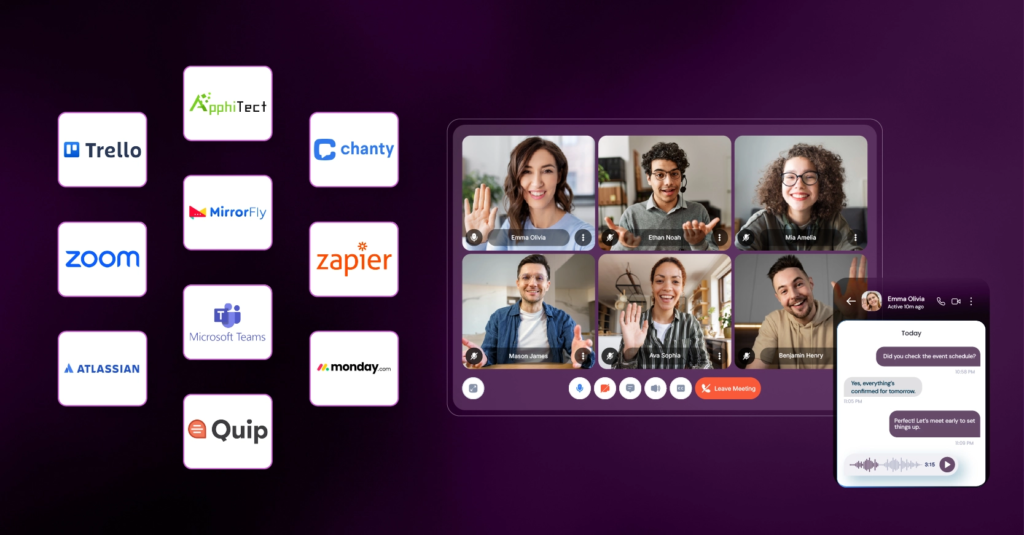
Modern AI meeting assistants integrate with project management and collaboration software such as Slack, Zoom, Microsoft Teams, Trello, and Google Workspace.
This integration allows meeting summaries, tasks, and reminders to update automatically across multiple platforms.
Employees no longer need to manually transfer notes or assign tasks after meetings.
Automation creates smoother workflows and improves workplace coordination significantly.
Benefits of AI Meeting Productivity Tools
AI-powered meeting tools provide several important advantages for businesses and professionals.
| Benefit | Impact |
|---|---|
| Time Savings | Faster workflows |
| Automated Notes | Reduced manual effort |
| Better Collaboration | Improved communication |
| Smart Scheduling | Organized meetings |
These benefits help organizations improve efficiency and employee productivity.
Challenges of AI Meeting Technology

Although AI meeting assistants improve productivity, businesses may still face some challenges during adoption.
Privacy concerns, transcription accuracy, internet dependency, and employee adaptation are common issues. Organizations must also ensure that sensitive meeting data remains secure.
Some AI tools may require training before employees can fully utilize advanced features.
Businesses should select reliable and secure platforms that match their workflow needs.
Future of AI Meeting Productivity
The future of AI meeting technology will focus on smarter automation, predictive scheduling, emotional analysis, and advanced collaboration systems.
AI assistants may soon provide live productivity recommendations during meetings and automatically generate workflow plans based on discussions.
Virtual reality collaboration and AI-powered digital workspaces are also expected to become more common in the future.
As artificial intelligence continues evolving, meetings are expected to become shorter, more organized, and significantly more productive.
Conclusion
AI meeting assistants and smart productivity tools are transforming modern workplaces by reducing time waste and improving workflow efficiency. Features such as automatic note-taking, smart scheduling, real-time transcription, and workflow automation help businesses organize meetings more effectively.
Organizations adopting AI-powered collaboration systems can improve communication, save time, and increase overall productivity. Remote teams especially benefit from automated summaries and cloud-based accessibility.
In 2026, AI meeting technology continues to reshape workplace collaboration and create smarter, faster, and more efficient business environments.